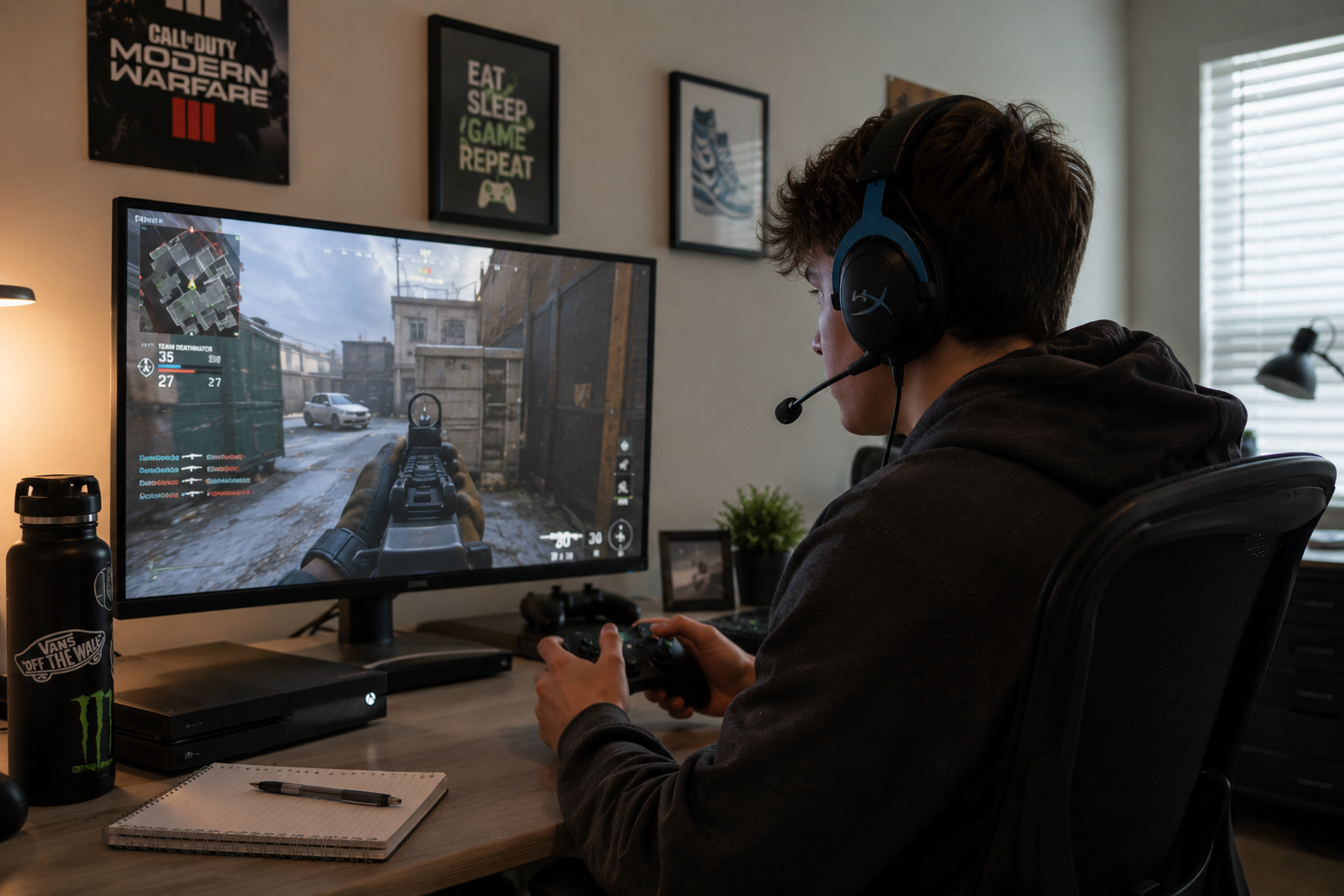
Video game addiction lawsuits seek to hold gaming companies accountable for exploiting vulnerable players, particularly minors and young adults, through intentionally addictive game designs.
Gaming addiction has caused significant harm, including mental health struggles, social isolation, sleep disruption, academic decline, financial strain, and family conflict. The lawsuits allege that gaming companies prioritized profit over user safety by designing games to keep children and young adults playing longer, spending more money, and returning even when the games were harming them.
Our attorneys examine claims involving Fortnite, Roblox, Minecraft, Call of Duty, Grand Theft Auto, Apex Legends, Madden, FIFA, and other online games. Below, we look at who may qualify, the video game addiction settlement value our lawyers project for successful claims, and the latest developments in court.
Who Is Eligible to File a Video Game Addiction Lawsuit?
Our firm currently accepts new video game addiction lawsuits, but we have specific criteria for eligible plaintiffs. We generally require all four of the following:
Current age: You or your child must be 24 years old or younger when contacting our firm.
Gaming history: At least 70 hours of video game use over a five-week period.
Diagnosed injury: A medically diagnosed condition, such as depression or anxiety, allegedly connected to gaming.
Treatment: Medical or mental health treatment for gaming addiction or an allegedly related disorder or injury.
These are our firm’s screening criteria. They are not legal requirements that apply to every video game addiction lawsuit. Meeting them does not establish that a game caused an injury.
We also review certain claims involving physical injuries, including seizures or orthopedic injuries. Those require an individual medical review of the alleged connection to gaming. A seizure diagnosis or a painful wrist, standing alone, does not establish a claim against a game company.
If your child has been harmed by gaming addiction, start gathering records now. Save game account data, purchase history, screen-time records, school records, therapy records, medical records, and any communications showing the struggle to restrict gaming. You do not need every record before contacting us.
Video Game Addiction Lawsuit Settlement Amounts
As of October 21, 2026, we have not identified a publicly reported settlement or jury verdict resolving a video game addiction personal injury case. The ranges below are what our lawyers believe successful claims could be worth.
Estimating potential settlement amounts in video game addiction lawsuits is difficult because the litigation is still developing. These cases are unique, and there are few comparable lawsuits to use when projecting payouts. Social media addiction litigation offers one comparison, but it involves different products and evidence.
With those caveats, our lawyers can provide general settlement payout estimates based on the alleged injuries and the way similar mental health and product liability cases are valued. These figures are our projections for successful claims, not an average drawn from completed video game addiction settlements.
Video game addiction lawsuits center on injuries tied to mental health conditions such as anxiety, depression, social isolation, sleep deprivation, aggression, and anger. Settlement compensation will likely vary depending on the severity of the impact on the plaintiff’s life. High-value settlements will likely involve plaintiffs who experienced life-altering consequences, such as severe depression or anxiety that led to dropping out of school, job loss, hospitalization, suicide attempts, or permanent disability.
If liability and causation can be proven, we believe these stronger cases may result in payouts of $100,000 to $350,000 or more, depending on the specific circumstances. Extraordinary cases involving permanent injury or death could push settlement amounts higher.
Cases involving less severe but documented injuries may result in lower settlement payouts. Our lawyers have projected a possible range of $25,000 to $90,000 for successful claims in that category. A temporary drop in grades or an argument over screen time, by itself, would not meet our firm’s screening criteria. The legal focus will remain on how gaming companies may have contributed to these harms through their design practices, and whether punitive damages are available.
What the 2026 Social Media Verdicts Tell Us
We now have an actual jury result in the related social media addiction litigation. On March 25, 2026, a Los Angeles jury awarded $6 million against Meta and YouTube together, including compensatory and punitive damages. Meta was assigned 70% and YouTube 30%. Meta disclosed the verdict and its appeal in its SEC filing.
That matters because a jury heard a claim about addictive platform design and put a substantial value on the injury. It gives us a real comparison when evaluating the potential of these cases. It does not establish a $6 million value for a video game claim, where the product, proof, defenses, and injury may be very different.
The day before, a New Mexico jury imposed $375 million in civil penalties against Meta in the attorney general’s consumer protection case. That award shows the financial stakes of institutional child safety claims. It was a government enforcement penalty, not compensation awarded to an individual family, so we do not use it as a per-person settlement benchmark.
The size of the injury is only part of the calculation. A serious diagnosis does not tell us which game contributed to it. A case with a clear timeline, treatment records, and account evidence may be easier to prove than a case involving the same injury and years of undocumented play across several games.
What Helps Establish the Value of a Gaming Addiction Claim
Issue
Evidence That Helps
Diagnosis and treatment
Mental health records, pediatric records, medication history, and hospitalization records.
School, work, and daily life
Attendance, grades, lost work, disrupted activities, and testimony explaining what changed.
Connection to a particular game
Account activity, screen-time data, purchases, messages, and a timeline connecting play to the injury.
Lasting consequences
Continuing treatment, disability evidence, future care needs, and expert opinions.
The best cases will have a young plaintiff, heavy use, documented injury, treatment history, school or work impact, and proof that game design fueled compulsive play or spending.
Video Game Addiction Lawsuit Updates
A Strong Claim Needs a Game-Specific Timeline
October 21, 2026:Our lawyers’ observation: Many children played several games. That creates a real proof issue. An account showing hundreds of gaming hours does not, by itself, explain how much Fortnite, Roblox, or Minecraft contributed to a child’s decline.
We want to know which games your child played, when play increased, what happened to sleep and school performance, and when treatment became necessary. If your child had ADHD or anxiety before gaming became a problem, those earlier records matter, too. They help show what changed afterward.
You do not need to reconstruct every match before calling. But “my child played constantly” gives us a starting point. A timeline connecting particular games to documented changes gives us something we can investigate and, potentially, prove.
Gaming Companies Lose Arbitration Requests in Pennsylvania Case
September 28, 2026: A federal court entered opinions rejecting arbitration requests by Roblox, Epic Games, Microsoft, and Mojang in Mercado v. Roblox Corporation. The opinions were signed September 25.
The same judge reached the opposite result in Tomlin in May, sending that case to arbitration. The account evidence and the agreements made by the parent and child were different. Mercado should not be read as a general ruling that minors’ gaming claims belong in court.
Judge Mia Roberts Perez found that the minor could disaffirm the Roblox agreement. That ruling matters because accepting online terms did not automatically close the courthouse door. You can read the Roblox opinion here.
Epic also failed to establish adequate notice with admissible evidence showing how its agreement appeared on the screen at the relevant time. The judge found disaffirmance provided another ground for rejecting Epic’s request. The Epic opinion shows why the account history and actual agreement presentation matter.
For Microsoft and Mojang, the court found that the minor had disaffirmed any agreement personally entered and that Microsoft had not established the guardian agreed on the minor’s behalf. These are case-specific contract rulings under Pennsylvania law. They preserve this plaintiff’s opportunity to litigate without establishing that the games caused the alleged injuries. See the Microsoft and Mojang opinion.
California Judge Tentatively Favors Arbitration in Four of Five Requests
August 4, 2026: Reporting on tentative rulings in JCCP No. 5363 described Judge Lawrence P. Riff as favoring arbitration in four of five requests. In the remaining request, Roblox failed to establish that a parent had agreed to its terms. These were reported as tentative rulings, rather than final orders resolving all arbitration questions in the coordinated proceeding.
For parents, the important point is the account evidence. Companies have had more success enforcing arbitration when they can establish adult acceptance. Where that proof is missing, a child’s ability to disaffirm an agreement may provide a way to keep the case in court. Continued use after disaffirmance and other contract provisions can also affect the result.
Read Earlier Video Game Addiction Lawsuit Updates
Pennsylvania Lawsuit Targets Roblox, Microsoft, Epic Games, and Mojang
June 4, 2026: A new lawsuit filed in Pennsylvania targets Roblox, Microsoft, Epic Games, and Mojang AB. The case alleges that a 15-year-old girl developed significant social and mental health problems after years of playing Roblox, Minecraft, and Fortnite. The lawsuit claims the companies used game mechanics that encourage compulsive play among minors.
This filing continues the trend of lawsuits naming multiple game companies together. The allegations focus on shared design features across popular youth games: reward loops, social pressure, in-game spending, achievement systems, and design features that make stopping difficult.
For parents, the claim sounds familiar. The child did not just enjoy the games. The games allegedly became the center of her life, pushing out sleep, school, friendships, activities, and emotional stability.
Nevada Teen Sues Roblox, Epic Games, Microsoft, and Mojang
June 3, 2026: A Nevada teenager filed a federal lawsuit against Roblox, Epic Games, Microsoft, and Mojang, alleging that Roblox, Fortnite, and Minecraft were intentionally designed to keep children playing and spending money through psychologically manipulative systems.
The Nevada filing fits the larger litigation pattern. The complaint does not treat video game addiction as a vague parenting dispute. It focuses on design choices: variable rewards, achievement systems, microtransactions, social competition, and behavioral science used to keep minors engaged.
Turner v. Epic Games and Roblox Filed in California
June 1, 2026: An Alabama mother filed Turner v. Epic Games Inc. and Roblox Corporation in the Northern District of California. The lawsuit alleges that Roblox and Fortnite were designed to be addictive through random reward tactics and other engagement systems aimed at minors. The minor plaintiff, now 10 years old, allegedly began playing Roblox and Fortnite at age five.
The case is worth watching because it was filed in the same federal district where many technology and platform cases are fought. It also mirrors the product-addiction theories being used in social media addiction lawsuits: companies understood how children respond to rewards, social feedback, and endless engagement systems, and chose growth and revenue over child safety.
The defendants will argue these are games, not defective products. Plaintiffs will answer that a product designed for children can be defective if the design foreseeably causes addiction, psychological injury, and financial harm.
Judge Perez Sends Another Gaming Addiction Case to Arbitration
May 20, 2026: In Tomlin v. Roblox Corporation, Judge Mia Roberts Perez granted arbitration requests by Epic, Roblox, and Microsoft and stayed the lawsuit. The opinion addresses the minor’s own acceptance, agreements accepted by the responsible adult, and contract provisions assigning certain disputes to the arbitrator.
The ruling explains why we ask who created the account. For Roblox and Microsoft, the court found the child could be bound as a beneficiary of an adult’s agreement. The opinion also treated the scope and effectiveness of disaffirmance differently across the agreements. A child clicking through terms and a parent accepting terms for the child can produce different legal problems.
New Jersey Video Game Addiction Claim
February 17, 2026: In a new lawsuit, a family from Burlington County, New Jersey, brought suit on behalf of their 15-year-old child, alleging that Roblox, Epic Games, Microsoft, and Mojang AB designed and marketed video game products that caused the minor to develop a severe and compulsive gaming addiction.
The child began playing video games at just three years old and, over time, became heavily engaged with Roblox, Fortnite, and Minecraft, primarily through Microsoft’s Xbox platform. According to the complaint, the companies intentionally incorporated addictive features designed to maximize screen time and microtransaction spending, despite longstanding research linking excessive gaming in minors to brain development impacts and behavioral addiction.
The family alleges that as a direct result of prolonged exposure to these products, the child developed a disordered pattern of use characterized by loss of control, compulsive play late into the night, and severe withdrawal symptoms when gaming access was restricted. The minor, who has been diagnosed with attention deficit hyperactivity disorder and anxiety, allegedly experienced worsening symptoms, including social withdrawal, isolation from friends and family, abandonment of sports and extracurricular activities, declining academic performance, and falling asleep in class due to late-night gaming. The complaint further describes aggressive outbursts, excessive and inappropriate language, anger, and property damage when attempts were made to limit gameplay.
Insurer Fights EA Over Coverage
February 17, 2026: Electronic Arts is facing a lawsuit brought by parents who allege the company intentionally designed its Battlefield games with psychologically addictive features that caused their son to develop gaming addiction and internet gaming disorder. The family claims the child plays 12 to 14 hours a day, spends hundreds of dollars monthly on in-game purchases, and has suffered academic problems, ADHD symptoms, physical pain, obesity, and emotional distress.
But instead of focusing solely on defending the addiction claims, EA is now in a major fight with its own insurer. National Casualty, a Nationwide unit, filed a declaratory judgment action in Arkansas federal court arguing that it has no duty to defend or indemnify EA because the lawsuit does not allege covered bodily injury or property damage caused by an accidental occurrence. The insurer also points to policy exclusions for intentional conduct, product performance issues, privacy-related claims, and punitive damages.
There are two battles playing out. Video game companies are fighting plaintiffs who allege that predatory game design harmed children, while also trying to shift part of the financial burden to their insurance carriers. Insurers are resisting, arguing that addiction claims stem from intentional business decisions and fall outside traditional commercial general liability coverage.
JPML Rejects Second Attempt to Create a Federal Video Game Addiction MDL
December 17, 2025: In a December 10 order, the Judicial Panel on Multidistrict Litigation rejected a second request for a video game addiction MDL. The panel remained concerned that additional games and defendants would make centralization unwieldy and identified informal coordination as an alternative.
The order addressed case management. It did not decide whether a particular game caused a child’s injury.
Lawsuit in Nevada
October 1, 2025: In a lawsuit filed in Nevada, a family from Jackson County, Missouri, alleges that their 12-year-old child developed a debilitating addiction to Roblox, Fortnite, and Minecraft, suffering significant emotional, physical, and cognitive harm.
The suit, brought in the U.S. District Court for the District of Nevada, argues that Roblox Corporation, Epic Games, and Microsoft intentionally designed their platforms to be addictive for minors, embedding behavioral reinforcement systems and manipulative in-game economies to maximize time spent in-game and revenue.
The complaint details how each company implemented psychological mechanisms such as operant conditioning, variable reward schedules, and achievement systems that encourage compulsive use. The developers, the family claims, failed to include adequate warnings or safeguards, despite longstanding research documenting the neurological impacts of excessive gaming on developing brains. The complaint alleges these design choices were grounded in internal expertise from psychologists and behavioral scientists retained by the companies to refine user engagement.
Particular attention is paid to Roblox Corporation, whose platform is positioned not only as a game but as a developmental ecosystem targeted at and shaped by children. The platform monetizes both user attention and user creativity, encouraging minors to design games for other minors, with monetization tools provided directly by the company. The lawsuit argues this has created a revenue model that relies on deep, sustained engagement from the youngest users.
Roblox is also facing a growing number of Roblox sexual abuse lawsuits alleging systemic failures to prevent or respond to child exploitation on its platform. That parallel litigation underscores the broader allegation that Roblox’s vulnerabilities may not be limited to persuasive design, but may reflect a deeper failure to protect its youngest users.
Video Game Addiction MDL
September 29, 2025: Parents are asking the Judicial Panel on Multidistrict Litigation to consolidate video game addiction lawsuits involving Fortnite, Roblox, and Minecraft in the Eastern District of Pennsylvania. The motion argues that these games share the same predatory design features, leading to a common harm: addiction among children and teens.
At first glance this might sound like a video game addiction class action lawsuit. It is not. These cases were proposed as an MDL, or multidistrict litigation. In an MDL, each plaintiff keeps an individual lawsuit, but pretrial discovery and rulings are coordinated before one judge to avoid duplication and inconsistent decisions. A few bellwether trials may then help gauge how juries respond to the evidence.
Meanwhile, Roblox is also facing a separate MDL petition over child exploitation claims, underscoring the growing scrutiny of platforms marketed to kids.
New Los Angeles Video Game Addiction Lawsuit
September 4, 2025: In a new lawsuit filed in Los Angeles County Superior Court, a family from Woodland Hills, California, is suing Epic Games and Microsoft over what they describe as the intentional design of addictive video games that caused serious harm to their 12-year-old son.
The case centers on Fortnite, Minecraft, and the Xbox platform. According to the complaint, the boy began playing the games at age six and over time developed a compulsive gaming habit marked by withdrawal symptoms, emotional volatility, and academic decline. The lawsuit argues these outcomes were not accidental. Instead, it claims the companies embedded psychological mechanisms like reward loops, dynamic pricing, and microtransaction prompts designed to keep young users engaged longer and spending more money.
The family says both companies failed to include basic safeguards, such as age verification, usage limits, or adequate parental controls, despite knowing the risks to minors. They also accuse the companies of marketing directly to children while misrepresenting the games as safe or even educational.
The complaint brings claims for strict liability, negligence, fraud, and unfair competition, and seeks compensatory and punitive damages.
California Video Game Addiction Litigation Is Still Growing
September 1, 2025: In California, under JCCP No. 5363, video game addiction lawsuits are coordinated in Los Angeles. The court is hearing claims that gaming companies knowingly used behavioral psychology, patented algorithms, and manipulative monetization tools to addict kids and maximize in-game purchases without meaningful parental controls, age verification, or warnings.
New Study Links IGD and Smartphone Overuse to Developmental Harm
June 27, 2025: A large-scale study found that 1.2 percent of children aged 10 to 14 meet the clinical threshold for Internet Gaming Disorder, while 2.7 percent meet subclinical levels. An even higher 9.9 percent of students were flagged for moderate to high smartphone addiction risk. The findings came from a self-report survey, rather than an experiment establishing what caused each child’s difficulties.
The study, which surveyed nearly 2,000 students, also found that children with Internet Gaming Disorder or problematic phone use scored significantly higher on measures of developmental harm, especially in emotional, social, and physical domains. The research documents an association between problematic use and developmental difficulties. It does not establish that a particular game caused an individual child’s injury.
New Lawsuit Alleges Fortnite and Minecraft Addiction
June 26, 2025: In a new lawsuit, a Los Angeles family brought claims against Epic Games, Inc. and Microsoft Corporation, alleging that their minor child developed a severe gaming addiction because of addictive features in games such as Fortnite and Minecraft. Filed in state court in Los Angeles County, the lawsuit was expected to be removed to federal court in the Central District of California.
The complaint asserts that the defendants knowingly engineered their games and platforms to exploit psychological vulnerabilities in minors, leading to emotional, psychological, and physical harm. The child began playing these games at age six and became increasingly dependent, resulting in deteriorating academic performance, disrupted sleep, and social withdrawal. The lawsuit alleges that attempts to limit the child’s screen time led to withdrawal symptoms, including rage and threats of self-harm, culminating in diagnoses of anxiety, depression, and symptoms of internet gaming disorder.
New Study Links Internet Gaming Disorder to Suicidal Ideation
June 15, 2025: A large-scale cohort study involving over 96,000 Chinese adolescents reported an association between Internet Gaming Disorder and the onset, persistence, and worsening of suicidal thoughts. The findings do not establish that a particular game caused suicidal thoughts in an individual child.
Consolidation of California Cases
May 7, 2025: The Judicial Council of California approved the consolidation of video game addiction lawsuits pending in the state’s courts into a single coordinated proceeding, designated as Judicial Council Coordinated Proceeding No. 5363. The California Judicial Council’s coordination log identifies Judge Lawrence P. Riff as the coordination trial judge. The consolidation creates a unified state-court structure for video game addiction lawsuits involving common allegations about addictive design, minors, and gaming-related injuries.
Illinois Court Dismisses Claims Against Roblox, Google, and Apple
April 23, 2025: Judge April M. Perry dismissed claims against Roblox, Google, and Apple in Angelilli v. Activision Blizzard, with permission to amend. The Google and Apple opinion found that the complaint did not adequately connect the child’s injury to either company’s conduct.
The separate Roblox opinion held that Section 230 and the First Amendment barred the addiction-related claims as pleaded, and that other claims were inadequately alleged. The court allowed amendment but expressed skepticism about overcoming those legal barriers.
This is why a complaint needs to identify what the particular defendant did and how that conduct allegedly caused the injury. Naming every company involved in a child’s gaming history does not supply that connection.
New Video Game Addiction Lawsuit Filed in Los Angeles Court
March 8, 2025: In a lawsuit filed in state court in Los Angeles, California, the family of a 13-year-old child sued Roblox Corporation, Epic Games, Microsoft, and Mojang, alleging that their video games are designed to be addictive to minors and cause severe harm. The lawsuit claims that these companies intentionally implemented manipulative game mechanics, psychological tactics, and monetization strategies to keep minors engaged for prolonged periods, leading to compulsive gaming behaviors.
The complaint states that the minor, identified as I.M., began playing video games at age five and developed addiction-like behaviors, including severe emotional distress, social isolation, withdrawal symptoms such as rage and anger, and an inability to regulate screen time. The lawsuit alleges that Roblox, Fortnite, and Minecraft lack proper parental controls, warnings, or time restrictions, despite the companies knowing about the risks of excessive gaming in minors.
New Video Explaining Lawsuits and Settlements
February 14, 2025: We put up a new video explaining these lawsuits and what our lawyers think successful video game addiction settlements would look like.
New Study Links Video Game Addiction to Aggression
February 7, 2025: A study titled Video Game Addiction and Aggression in Schools: A Study of Moroccan Adolescents’ Behavioral Patterns found a positive correlation between video game addiction and aggressive behavior among adolescents aged 15 to 19. The research indicates that teens addicted to violent video games, particularly those depicting war and combat, are more likely to exhibit aggressive behaviors in school settings.
The reported correlation does not establish that violent games caused the behavior or that the findings apply to every game.
California Family Sues Roblox and Google in Gaming Addiction Lawsuit
January 28, 2025: In a video game addiction lawsuit filed in Fresno County Superior Court, a California family alleges that Roblox Corporation and Google knowingly designed and distributed addictive gaming products that harmed their 11-year-old child. The complaint claims that Roblox uses patented addictive design features such as operant conditioning systems, loot boxes, and microtransactions that exploit young users.
The family contends that Roblox and Google failed to warn parents of the risks of gaming addiction while actively marketing Roblox as an educational and creative platform. The child allegedly developed compulsive gaming habits, withdrawal symptoms, and cognitive and social harms.
Lawsuit Alleges Addiction Caused Severe Psychological Harm
January 7, 2025: In a video game addiction lawsuit filed in Alameda County, California, the family of a minor, referred to as A.G., sued major gaming companies including Roblox Corporation, Epic Games, Microsoft, Mojang, Sony Interactive Entertainment, and Nintendo. The suit claims these companies engineered games such as Roblox, Minecraft, and Fortnite to hook young players through psychological tactics and monetization schemes.
The lawsuit alleges these games use operant conditioning, AI-driven feedback loops, and monetization systems that exploit children’s psychological vulnerabilities, leading to compulsive use and severe psychological harm, including sleep deprivation, anxiety, depression, and social isolation. A.G. allegedly engaged in gaming sessions lasting more than 12 hours a day, while the family also experienced financial strain from in-game purchases.
New Minecraft Addiction Case in California
November 20, 2024: In a lawsuit filed in California state court, a family sued Roblox, Microsoft, and others, alleging they exploited addictive designs in Minecraft. The complaint asserts that the game was deliberately engineered to target psychological vulnerabilities, particularly among minors and neurodivergent individuals, resulting in mental, emotional, and physical harms.
The family also alleges that the companies violated privacy laws by collecting personal information from minors without proper parental consent. The case joins a growing wave of litigation scrutinizing the gaming industry’s impact on vulnerable children.
Motion to Dismiss Video Game Addiction Lawsuit
September 19, 2024: Activision Blizzard, Roblox, Microsoft, Nintendo, and other major video game companies filed motions to dismiss a lawsuit alleging they intentionally designed their games to be addictive for profit. The companies argued that video games are protected by the First Amendment and that the claims should be barred by statutes of limitations and other defenses.
Plaintiffs respond that these lawsuits are not trying to ban creative expression. They are product defect and failure-to-warn cases challenging harmful design choices, similar to claims against companies that sell products known to cause foreseeable injury.
Later outcome: The April 23, 2025 Angelilli opinions, summarized above, dismissed the claims against Roblox, Google, and Apple as pleaded, with leave to amend.
Federal Panel Declines First Video Game Addiction MDL Request
June 10, 2024: In a June 5 order, the Judicial Panel on Multidistrict Litigation denied the first request to centralize video game addiction cases. Plaintiffs had proposed the Western District of Missouri. The panel found that differences among the games, defendants, and allegations outweighed the benefits of centralization.
An MDL would coordinate individual lawsuits for federal pretrial proceedings. It would not turn them into a class action.
Addiction to Video Games
Video game addiction can significantly impair an individual’s control over gaming. Gaming begins to take priority over essential life activities, affecting self-care, relationships, school, work, and family life.
The World Health Organization recognizes gaming disorder in the ICD-11 as a pattern of gaming behavior characterized by impaired control over gaming, increasing priority given to gaming over other activities, and continued gaming despite negative consequences.
Plaintiffs allege that easy access, constant updates, in-game purchases, social pressure, and games designed around daily engagement can intensify compulsive play, particularly among minors and young adults. Plaintiffs argue this widespread problem is driven by companies intentionally designing games to increase play time and spending through microtransactions.
The American Psychiatric Association discusses internet gaming disorder as a condition requiring further research in DSM-5-TR. The terminology and diagnostic frameworks are not identical. A clinician should assess the child’s symptoms, history, and other conditions.
Lawsuits for Video Game Addiction
Legal actions are being taken against these companies, accusing them of employing deceptive practices that prioritize profit over user safety. Our allegations focus heavily on minors and young adults, who may be less able to appreciate the risks of compulsive gaming or resist behavioral design techniques.
The video game addiction lawsuits seek to hold video game companies liable based on defective design and failure-to-warn theories. The lawsuits assert that the companies had a duty to warn users and parents that their games could be addictive and habit-forming, and that this addiction could cause serious harm.
The lawsuits also allege that game companies could have used safer designs. Those safer alternatives include stronger parental controls, age verification, default play-time limits, spending limits, clear warnings, removal of manipulative reward systems, and reduced pressure to make in-game purchases.
Video Game Design Features Plaintiffs Are Targeting
The lawsuits do not attack video games just because they are enjoyable. They focus on design features that allegedly push minors toward compulsive play and spending.
Variable Rewards
How It Works: Rewards arrive unpredictably, encouraging repeated play.
Why Plaintiffs Say It Is Dangerous: Children keep playing because the next reward could arrive at any time.
Microtransactions
How It Works: Players buy skins, upgrades, currency, passes, or chances at rewards.
Why Plaintiffs Say It Is Dangerous: Spending becomes tied to social status, progress, and emotional reward.
Battle Passes and Daily Quests
How It Works: Players must return regularly to complete goals before time runs out.
Why Plaintiffs Say It Is Dangerous: The game creates pressure to play even when the child should sleep, study, or stop.
Social Pressure
How It Works: Friends, teams, chats, clans, and rankings keep the child tied to the game.
Why Plaintiffs Say It Is Dangerous: Leaving the game can feel like losing friends, status, or progress.
No Natural Stopping Point
How It Works: The game constantly refreshes with new goals, matches, content, and rewards.
Why Plaintiffs Say It Is Dangerous: A child may keep playing long after they intended to stop.
Our lawyers’ design-defect theory is that gaming companies used known psychological tools to increase play time and spending while failing to protect minors from foreseeable harm.
The crux of these lawsuits is that these games target minors and young adults. Our lawyers claim that the defendants deliberately designed their products to exploit vulnerable users’ inability to appreciate risks, making the products exceptionally addictive. How did they do that? They used psychological tactics, such as random rewards and social components, to increase addictiveness. The product liability angles are defective design and failure to warn.
What Evidence Helps Prove a Video Game Addiction Lawsuit?
Gather game account records, screen-time data, purchase history, bank or credit card records, app store records, school records, therapy records, psychiatric records, pediatric records, screenshots, and any notes showing when your child’s behavior changed.
The records need to tell a story that holds together. When did the gaming increase? When did the child start missing school or sleeping through class? What did the pediatrician or therapist record at the time? A treatment note written before anyone considered a lawsuit may help establish when the problems began.
What If My Child Already Had ADHD, Anxiety, or Depression?
Tell us. Earlier problems do not automatically rule out a claim, but they affect what must be proven. We need to understand the child’s condition before the gaming escalated and the changes that followed. The defense will examine the same history.
A child who was doing well with treatment and then stopped sleeping, attending school, or seeing friends presents a different history from a child whose symptoms remained unchanged. Medical records, school records, and people who knew the child during both periods can help explain the difference.
What Should I Save Before Closing an Account?
Save account names, associated email addresses, purchase receipts, available activity records, and communications with the companies. Identify who created each account and whether a parent accepted any terms. Preserve the records you have rather than deleting accounts or messages that may be relevant.
You should not keep a child playing to collect evidence. Treatment and safety come first. Ask your lawyer how to preserve available records while restricting access.
You do not have to organize years of records before calling. Tell us which games your child played, what changed, and what treatment your child received. We can help identify the information needed to evaluate the claim.
Who Are the Defendants in the Video Game Lawsuits?
The defendants named across video game addiction complaints include many of the major players in the gaming industry. The companies named vary by case, and a company’s appearance in a complaint is not a finding of liability.
Epic Games, Inc.: known for developing and selling Fortnite.
Roblox Corporation: associated with the development and sale of the Roblox platform.
Activision Blizzard, Inc.: developer of the Call of Duty series and a Microsoft subsidiary since Microsoft completed its acquisition in October 2023.
Infinity Ward, Inc.: involved in developing and marketing the Call of Duty series.
Treyarch Corp.: another contributor to the Call of Duty series.
Sledgehammer Games, Inc.: part of the team behind Call of Duty.
Raven Software Corporation: engaged in Call of Duty development and distribution.
War Drum Studios LLC d/b/a Grove Street Games: known for work related to Grand Theft Auto.
Rockstar North Limited: a primary developer of the Grand Theft Auto series.
Rockstar Games, Inc.: involved in the Grand Theft Auto series.
Take-Two Interactive Software, Inc.: parent company of Rockstar Games and Rockstar North.
Sony Interactive Entertainment LLC: alleged to have contributed through distribution and marketing through the PlayStation platform.
Microsoft Corporation: discussed in the context of Xbox, Minecraft, and related services.
Nintendo of America, Inc.: alleged involvement through Nintendo Switch and related services.
2K Games Inc.: known for sports games such as NBA 2K and WWE 2K.
Apple Inc.: involved through the App Store.
Another Axiom, Inc.: known for Gorilla Tag.
Dell Inc. and Dell Technologies Inc.: devices used to play video games.
Electronic Arts Inc.: developer of FIFA, Madden NFL, Battlefield, and other games.
Google LLC: operates Google Play and distributes games.
Innersloth LLC: known for Among Us.
Meta Platforms, Inc.: develops and supports virtual reality gaming platforms through Oculus VR.
Mojang AB: the Minecraft developer named in the litigation, known publicly as Mojang Studios.
Rec Room Inc.: developer of Rec Room.
Ubisoft Entertainment: known for Assassin’s Creed, Far Cry, and other franchises.
Visual Concepts Entertainment Studios: involved in sports simulation games such as NBA 2K.
Is There a Video Game Addiction Class Action Lawsuit for Injury Victims?
These injury claims are generally individual lawsuits. An MDL coordinates federal pretrial proceedings while each plaintiff keeps an individual case. A class action instead seeks relief for a defined group through representative plaintiffs.
The federal panel denied centralization in 2024 and again in December 2025. California has a separate coordinated proceeding, JCCP No. 5363. Federal MDL centralization would not itself eliminate otherwise available state-court claims.
An MDL can be useful, but it can also slow individual cases and make plaintiffs feel like numbers. Individual stories can get buried in the volume of cases. Our lawyers see potential advantages in proceeding in several courts, but avoiding an MDL does not guarantee faster trials. The December order noted that the earlier group of cases had been dismissed or stayed for arbitration.
Does Accepting a Game’s Terms Mean I Cannot Sue?
It can affect whether your claim proceeds in court or arbitration. Gaming companies have won arbitration requests as well as lost them. The identity of the person who agreed to the terms is one of the first facts we need to know.
When a parent accepted an enforceable agreement for the child’s benefit, courts have required arbitration. When only the minor agreed, state law may allow the minor to disaffirm the contract. But minor-only acceptance does not automatically keep a case in court. Continued use, notice of the terms, and provisions assigning questions to an arbitrator can also matter.
Judge Perez’s Tomlin and Mercado decisions illustrate why the details matter. A parent cannot assume that the child’s age defeats arbitration, and a company cannot simply assume that a parent accepted an agreement because money was spent on an account.
Tell us who created the account, who accepted terms, and whether the account continued to be used after anyone challenged the agreement. Save notices and emails. A lawyer should review those facts before you make changes intended to affect contractual rights.
Section 230 and the First Amendment Are Substantial Defenses
Section 230 generally protects online services from liability that treats them as the publisher or speaker of content supplied by someone else. Gaming companies also argue that video games are protected expression under the First Amendment.
In Angelilli, those defenses helped defeat the addiction claims against Roblox as pleaded. Calling a claim “defective design” did not, by itself, get around the court’s analysis. Other claims were dismissed for pleading deficiencies, and the court allowed amendment.
Our lawyers have to identify the company’s own allegedly harmful conduct, the product features involved, and how those features contributed to the injury. The distinction between a company’s own conduct and its role in presenting someone else’s content can determine whether a claim survives. The answer depends on the actual allegations, rather than the label placed on the lawsuit.
What Is the Deadline to File a Video Game Addiction Lawsuit?
The deadline depends on the state law governing the claim, the person’s age, the type of claim, and when the injury and its alleged cause were discovered. Rules that extend time for minors vary. You should not assume that being under 18 preserves every claim indefinitely.
Give your lawyer the dates when gaming began, when serious problems appeared, and when treatment started. Waiting for a trial result in another family’s case can put your own claim at risk.
Frequently Asked Questions About Video Game Addiction Lawsuits
These lawsuits are not just about kids playing too many video games. The claims focus on allegedly addictive design, lack of warnings, weak safeguards, and serious harm to minors and young adults.
What is the basis of the video game addiction lawsuits?
These lawsuits claim that gaming addiction is not merely an accident or ordinary overuse. Plaintiffs allege that companies used behavioral psychology, gambling-like mechanics, reward systems, in-game economies, social pressure, and microtransactions to keep players engaged and spending. The legal theories that support these claims are defective design, failure to warn, negligence, fraud, and consumer protection claims.
What game companies are being sued for gaming addiction?
The companies include Epic Games, Roblox Corporation, Microsoft, Mojang, Activision Blizzard, Electronic Arts, Take-Two Interactive, Rockstar Games, Sony, Nintendo, Google, Apple, and others. The specific defendants depend on the games and platforms the plaintiff used.
How do gaming companies allegedly make games addictive?
Plaintiffs point to variable reward systems, loot boxes, microtransactions, daily streaks, limited-time events, battle passes, social pressure, progression systems, and games without natural stopping points. Plaintiffs allege these features keep minors playing longer and spending more while exposing them to foreseeable harm.
How do I know if my child has a gaming addiction?
Parents often recognize that something has changed long before they have a diagnosis. Warning signs include loss of interest in other activities, rage or withdrawal when gaming is restricted, falling grades, sleep loss, lying about gaming time, isolation from friends and family, compulsive spending, and inability to stop despite consequences. A clinician should evaluate these symptoms and other possible explanations.
What injuries and health problems are linked to video game addiction?
Alleged injuries include depression, anxiety, social isolation, sleep deprivation, suicidal ideation, aggression, internet gaming disorder, repetitive stress injuries, headaches, vision problems, obesity, academic decline, and financial harm from in-game purchases.
How much is a video game addiction lawsuit worth?
Our lawyers estimate that if the claims are successful, severe cases may fall in the $100,000 to $350,000 range or higher, depending on diagnosis, treatment, school disruption, physical harm, spending, and the strength of the design-defect evidence. Our lawyers have projected $25,000 to $90,000 for successful claims involving less severe but documented injuries. These are our projections, not an established payout schedule. Exceptional cases involving death or permanent institutionalization would likely be worth much more.
What should I do if I want to file a video game addiction lawsuit?
Gather game account records, screen-time data, purchase history, bank or credit card records, app store records, school records, therapy records, psychiatric records, pediatric records, screenshots, and any notes showing when your child’s behavior changed. Then contact a lawyer (us, for example) who is investigating these claims. You do not need every record before making that call.
Is the video game addiction lawsuit real?
Yes. Families have filed individual injury lawsuits against gaming companies. A filed lawsuit contains allegations that still must be proven. Whether your family has a viable claim requires an individual review.
How do I sign up for a video game addiction lawsuit?
Start with a case evaluation. Tell us the player’s age, the games involved, the approximate gaming history, the injury, and the treatment received. Our lawyers will review whether the facts meet our firm’s screening criteria and support further investigation.
Can a parent contact a lawyer for a child?
Yes. A parent or guardian can contact us about a minor’s potential claim. We will need to understand the child’s injury and treatment, as well as who created and used the gaming accounts.
Is there a video game addiction settlement?
As of October 21, 2026, we have not identified a publicly reported settlement or jury verdict resolving a video game addiction personal injury case. Our settlement ranges are projections for successful claims. Refund programs, privacy settlements, and government enforcement cases involving games address different claims.
Can adults file a video game addiction lawsuit?
Yes. Adults may have potential claims, subject to the governing law, evidence, and filing deadline. Our firm currently reviews these cases for people who are 24 or younger when contacting us and who meet our other screening criteria. That is our intake policy, not a legal age limit on every claim.
Contact Us About Video Game Addiction Lawsuits
Our firm is seeking video game addiction lawsuits nationwide. If you or your child suffered physical or mental harm as a result of video game addiction, call us today for a free case evaluation.
{
“@context”: “https://schema.org”,
“@type”: “FAQPage”,
“mainEntity”: [
{
“@type”: “Question”,
“name”: “What is the basis of the video game addiction lawsuits?”,
“acceptedAnswer”: {
“@type”: “Answer”,
“text”: “These lawsuits claim that gaming addiction is not merely an accident or ordinary overuse. Plaintiffs allege that companies used behavioral psychology, gambling-like mechanics, reward systems, in-game economies, social pressure, and microtransactions to keep players engaged and spending. The legal theories that support these claims are defective design, failure to warn, negligence, fraud, and consumer protection claims.”
}
},
{
“@type”: “Question”,
“name”: “What game companies are being sued for gaming addiction?”,
“acceptedAnswer”: {
“@type”: “Answer”,
“text”: “The companies include Epic Games, Roblox Corporation, Microsoft, Mojang, Activision Blizzard, Electronic Arts, Take-Two Interactive, Rockstar Games, Sony, Nintendo, Google, Apple, and others. The specific defendants depend on the games and platforms the plaintiff used.”
}
},
{
“@type”: “Question”,
“name”: “How do gaming companies allegedly make games addictive?”,
“acceptedAnswer”: {
“@type”: “Answer”,
“text”: “Plaintiffs point to variable reward systems, loot boxes, microtransactions, daily streaks, limited-time events, battle passes, social pressure, progression systems, and games without natural stopping points. Plaintiffs allege these features keep minors playing longer and spending more while exposing them to foreseeable harm.”
}
},
{
“@type”: “Question”,
“name”: “How do I know if my child has a gaming addiction?”,
“acceptedAnswer”: {
“@type”: “Answer”,
“text”: “Parents often recognize that something has changed long before they have a diagnosis. Warning signs include loss of interest in other activities, rage or withdrawal when gaming is restricted, falling grades, sleep loss, lying about gaming time, isolation from friends and family, compulsive spending, and inability to stop despite consequences. A clinician should evaluate these symptoms and other possible explanations.”
}
},
{
“@type”: “Question”,
“name”: “What injuries and health problems are linked to video game addiction?”,
“acceptedAnswer”: {
“@type”: “Answer”,
“text”: “Alleged injuries include depression, anxiety, social isolation, sleep deprivation, suicidal ideation, aggression, internet gaming disorder, repetitive stress injuries, headaches, vision problems, obesity, academic decline, and financial harm from in-game purchases.”
}
},
{
“@type”: “Question”,
“name”: “How much is a video game addiction lawsuit worth?”,
“acceptedAnswer”: {
“@type”: “Answer”,
“text”: “Our lawyers estimate that if the claims are successful, severe cases may fall in the $100,000 to $350,000 range or higher, depending on diagnosis, treatment, school disruption, physical harm, spending, and the strength of the design-defect evidence. Our lawyers have projected $25,000 to $90,000 for successful claims involving less severe but documented injuries. These are our projections, not an established payout schedule. Exceptional cases involving death or permanent institutionalization would likely be worth much more.”
}
},
{
“@type”: “Question”,
“name”: “What should I do if I want to file a video game addiction lawsuit?”,
“acceptedAnswer”: {
“@type”: “Answer”,
“text”: “Gather game account records, screen-time data, purchase history, bank or credit card records, app store records, school records, therapy records, psychiatric records, pediatric records, screenshots, and any notes showing when your child’s behavior changed. Then contact a lawyer (us, for example) who is investigating these claims. You do not need every record before making that call.”
}
},
{
“@type”: “Question”,
“name”: “Is the video game addiction lawsuit real?”,
“acceptedAnswer”: {
“@type”: “Answer”,
“text”: “Yes. Families have filed individual injury lawsuits against gaming companies. A filed lawsuit contains allegations that still must be proven. Whether your family has a viable claim requires an individual review.”
}
},
{
“@type”: “Question”,
“name”: “How do I sign up for a video game addiction lawsuit?”,
“acceptedAnswer”: {
“@type”: “Answer”,
“text”: “Start with a case evaluation. Tell us the player’s age, the games involved, the approximate gaming history, the injury, and the treatment received. Our lawyers will review whether the facts meet our firm’s screening criteria and support further investigation.”
}
},
{
“@type”: “Question”,
“name”: “Can a parent contact a lawyer for a child?”,
“acceptedAnswer”: {
“@type”: “Answer”,
“text”: “Yes. A parent or guardian can contact us about a minor’s potential claim. We will need to understand the child’s injury and treatment, as well as who created and used the gaming accounts.”
}
},
{
“@type”: “Question”,
“name”: “Is there a video game addiction settlement?”,
“acceptedAnswer”: {
“@type”: “Answer”,
“text”: “As of October 21, 2026, we have not identified a publicly reported settlement or jury verdict resolving a video game addiction personal injury case. Our settlement ranges are projections for successful claims. Refund programs, privacy settlements, and government enforcement cases involving games address different claims.”
}
},
{
“@type”: “Question”,
“name”: “Can adults file a video game addiction lawsuit?”,
“acceptedAnswer”: {
“@type”: “Answer”,
“text”: “Yes. Adults may have potential claims, subject to the governing law, evidence, and filing deadline. Our firm currently reviews these cases for people who are 24 or younger when contacting us and who meet our other screening criteria. That is our intake policy, not a legal age limit on every claim.”
}
}
]
}
 Lawsuit Information Center