 Lawsuit Information Center


Our lawyers are now focusing our attention on the Medtronic Bravo CF capsule recall.
This device is used to diagnose acid reflux and gastroesophageal reflux disease (GERD). In September 2026, the FDA classified a major recall of these devices as Class I, the agency’s most serious recall category.
This should be a simple no-frills test. A doctor attaches a small capsule to the lining of the patient’s esophagus. The capsule measures acidity and transmits readings to a receiver the patient wears. The goal is to determine whether the patient has acid reflux.
It sounds simple enough. But there is a problem that even Medtronic has acknowledged with the system used to place the capsule. The capsule sometimes fails to attach to the esophagus or to separate properly from the delivery device. The capsule can enter the airway, cause an obstructed airway, bleeding, an esophageal tear or perforation, or require another procedure to retrieve the device.
According to the FDA’s September 2026 recall announcement, Medtronic reported 184 serious injuries. The FDA’s recall database lists 127,416 devices in commerce worldwide. We do not know how many injuries were never reported. Still, it is a remarkable number of reported serious injuries involving a simple test people undergo to find out why they have heartburn.
Here is the number that really interests us. Medtronic’s own August 2026 field safety notice says the company received 761 complaints involving Bravo capsules that failed to attach or detach properly between January 1, 2025, and July 7, 2026. Of those complaints, 184 involved serious patient injuries. That is nearly one in four complaints. It is not the injury rate for everyone who underwent a Bravo test. But it gives our lawyers a very specific question to investigate: what did Medtronic know, and when did it know it?
Our product liability lawyers are investigating potential Medtronic Bravo capsule injury claims. This page explains which devices were recalled, how the failure can injure a patient, what records can establish whether a recalled device was used, and what compensation may be available to someone who suffered a serious injury.
If you underwent a Bravo pH test and suffered a serious complication requiring emergency treatment, endoscopic removal, hospitalization, or surgery, call 800-553-8082 or contact our lawyers online for a free case review.
By Ronald V. Miller Jr., Trial Lawyer
Last updated: October 25, 2026
Medtronic Bravo Capsule Recall: October 2026 Status
The current recall involves the Bravo CF capsule delivery device, manufactured by Given Imaging, a Medtronic subsidiary. It is the disposable device doctors use to position and attach a wireless pH-monitoring capsule to the patient’s esophagus.
The 127,416 figure is the number of devices the FDA lists in commerce across worldwide distribution. It is not a count of injured people or a count of devices used on U.S. patients.
What does Class I mean? Class I means that it is a big deal. The FDA considers these recalls to involve a reasonable probability that continued use of an affected product could cause serious adverse health consequences or death. It is the highest-risk classification the FDA uses for medical device recalls.
The FDA also issued an earlier Class I recall of certain Bravo CF delivery devices in June 2025. That involved the same models and similar deployment problems, but Medtronic pointed to yet another underlying manufacturing cause.
The FDA’s official 2026 recall database entry provides the product identification, reported cause, affected inventory, and recall status.
Who May Qualify for a Medtronic Bravo Capsule Lawsuit?
We are interested in investigating cases where a person underwent Bravo pH monitoring and suffered a significant injury that may be connected to a malfunction of the capsule delivery system.
Just having a Bravo test performed is not enough. And just because a device was recalled does not mean everyone who received it has a viable personal injury lawsuit.
What our lawyers want to know is what happened during the procedure, what the doctors found, whether an affected device was used, and how seriously the patient was injured.
Potential Bravo Capsule Injury Claims
Capsule aspiration: The capsule entered or may have entered the patient’s airway, requiring emergency evaluation, bronchoscopy, or another procedure.
Airway obstruction: The patient was choking, had difficulty breathing, or experienced another serious respiratory complication associated with placement of the device.
Esophageal perforation or laceration: The capsule or delivery device allegedly caused a tear, puncture, or other injury requiring treatment.
Significant bleeding: The patient suffered hemorrhage, substantial blood loss, or another bleeding complication associated with the device.
Emergency removal or corrective procedure: The patient required an additional endoscopy, bronchoscopy, surgery, or other intervention because the capsule was misplaced, retained, or malfunctioned.
Other documented serious complications: We can also investigate unusual complications involving a failed deployment, retained foreign body, hospitalization, or substantial additional treatment.
The strongest cases will generally have medical records that clearly show what went awry. An endoscopy report describing a capsule that would not release, a bronchoscopy showing a foreign body in the airway, or an operative report documenting esophageal injury are the kinds of things we expect to find in the medical records. Those records tell a much clearer picture of what happened than a patient simply reporting that the test was uncomfortable.
What If I Do Not Know Whether My Bravo Device Was Recalled?
That is what we expect. Most patients have no idea what model or lot number was used during an endoscopic procedure.
Unlike someone who receives an artificial hip or another permanent implant, a patient undergoing Bravo monitoring is not usually given a device card containing the product number and manufacturing information. But that is okay. The hospital or endoscopy center should be our starting point. The procedure record, supply records, product labels, purchase records, or inventory system may identify the device used. Sometimes the lot number is not in the medical chart, and we have to dig further.
So do not assume there is no potential case simply because you do not know the lot number. In many cases, we can figure it out. That is part of the investigation our lawyers will undertake.
Do Not Wait to Investigate a Bravo Capsule Injury
Some of the reported Bravo capsule problems date back to January 2025. That matters because the deadline for filing a product liability lawsuit can be surprisingly short. In some states, the general personal injury limitations period is one year. In others, it is two years or longer. When the claim legally accrued, discovery rules, and other state-specific provisions can change the deadline. Some patients injured in 2025 may already face a limitations problem. Do not assume the September 2026 recall announcement started a new clock.
Injured During a Bravo pH Test?
If you suffered a serious complication during or after a Medtronic Bravo capsule procedure, our lawyers can investigate whether the medical records support a claim involving the recalled device.
Call 800-553-8082 or contact us online for a free consultation.
Which Medtronic Bravo Capsules Were Recalled?
The 2026 recall covers specific lots of two Bravo CF capsule delivery device configurations.
| Recalled Product | Product Number | UDI-DI / GTIN |
|---|---|---|
| Bravo CF capsule delivery device, five-pack | FGS-0635 | 07290101369707 |
| Bravo CF capsule delivery device, single-pack | FGS-0636 | 07290101369714 |
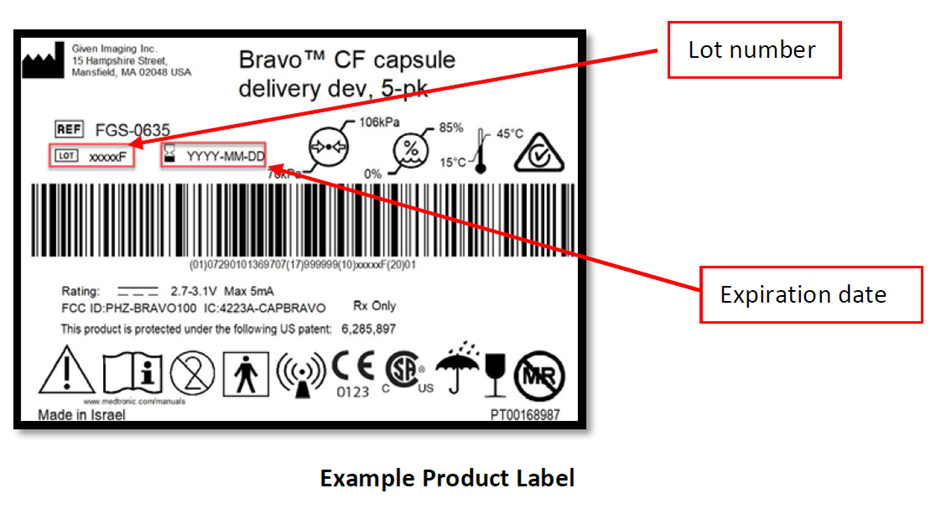
According to the FDA, the affected lots in the 2026 recall have expiration dates through October 20, 2027. The recall database describes affected lot numbers ranging from 64553F through 68912F. In these cases, we need to check the actual lot number against the FDA’s complete recall information. An expiration date or model number alone will not be enough to establish that the particular delivery device was recalled.
Medtronic says that lots with expiration dates of December 10, 2027, or later are outside the 2026 recall. If there is uncertainty about a lot manufactured between the specified dates, the hospital or Medtronic should verify it using the recall documentation. The official FDA recall page links to the complete list of affected lots and includes an example product label showing where the identifying information appears. But we also are not going to assume that the only lots we should be worried about are the ones Medtronic says we should be worried about. The recall tells us which lots Medtronic identified. It does not foreclose an investigation of another lot if the records show the same type of failure.
If your Bravo test was in 2025 or 2026, particularly if something went wrong during placement, we want to look at which device was used. Both recalls involve products that may have been used during that period. You do not need the lot number before you contact us.
Why Product Identification Is So Important
The manufacturer has acknowledged a problem affecting certain devices. But the fact that a device shares the Bravo name does not definitively establish that it was part of the recall.
Diagnostic equipment comes in multiple generations and configurations. We need the exact product and, preferably, the lot number. These details may also help distinguish the 2025 adhesive-related recall from the separate 2026 deployment-component recall. The identification process is particularly important when, in most cases, the capsule has already passed through the digestive tract and is no longer available for examination.
How Does the Medtronic Bravo Capsule Delivery Device Fail?
Again, the Bravo system uses a small capsule attached temporarily to the esophagus. During placement, a doctor advances the capsule into position using a disposable delivery device. The capsule is supposed to attach to the lining of the esophagus, separate from the delivery device, and remain in place long enough to collect pH measurements. Once the capsule is attached, the doctor withdraws the delivery device. The capsule continues transmitting data to a receiver worn by the patient.
Medtronic identified two ways that the placement process might fail:
1. The Capsule Fails to Attach to the Esophagus
The device fails to secure the capsule to the esophageal lining. That creates an obvious problem. The capsule is supposed to remain in a specific location while the applicator is withdrawn. If it does not attach, it may be displaced or go somewhere we do not want it to go. Medtronic’s own product safety information acknowledges the possibility that a capsule that fails to attach may be inadvertently pulled back into the upper esophagus by the delivery device. That situation can create a risk of aspiration.
Swallowing a small object that passes through the digestive tract is very different from having that object enter the airway. If a capsule enters the trachea or another part of the respiratory system, the result can be a medical emergency.
2. The Capsule May Fail to Release From the Delivery Device
The second problem is that the capsule may not detach properly from the applicator during placement.
If the capsule remains attached to the delivery device while the physician attempts to withdraw it, there is a potential for injury to the esophageal lining or other complications.
The precise consequences depend on what happened during the procedure and whether the failure was recognized immediately.
According to Medtronic’s 2026 recall information, the problem may involve a component that controls deployment of the capsule. The company also states that the issue can be made worse if the delivery device is not kept straight as directed in the User Guide.
The nuance will matter as these lawsuits develop. Medtronic may contend that improper handling contributed to an injury. Plaintiffs will argue that a device used in a foreseeable clinical setting should not malfunction in a way that exposes a patient to serious harm, particularly if a manufacturing problem contributed to that failure. Our lawyers will need to investigate both possibilities.
A Normal Capsule Detachment Is Different
Again, the Bravo capsule is supposed to detach naturally from the esophagus several days after the test. Once it has completed its monitoring period, the capsule should release from the esophageal wall and pass through the digestive tract. According to Johns Hopkins, that typically happens within approximately four to ten days after the test begins.
The 2026 recall primarily concerns failure to attach the capsule to the esophagus or failure to release it from the delivery device during placement. Those events should not be confused with the capsule’s expected separation from the esophageal wall days later.
The system has other recognized risks, including premature separation from the esophagus or failure to release normally after the test. Those complications require their own medical investigation and are not automatically evidence of the particular manufacturing problem identified in the 2026 recall.
Injuries Associated With the Recalled Bravo Capsule Delivery Device
The FDA identifies several potentially serious injuries associated with the deployment problem.
Capsule Aspiration and Airway Obstruction
One of the most concerning risks is aspiration, meaning the capsule enters the airway rather than following the normal path through the esophagus and digestive system. A foreign object in the airway can cause coughing, breathing difficulties, obstruction, and potentially life-threatening respiratory complications. Depending on its location, a misplaced capsule can require urgent evaluation and a procedure such as bronchoscopy to locate and remove it.
For lawyers investigating these cases, the location of the capsule will make a difference. Imaging, bronchoscopy reports, anesthesia records, and emergency department records can establish whether it entered the airway and what doctors had to do to remove it.
These are potentially strong liability and damages facts because the injury can be documented directly.
Esophageal Perforation
A perforation is a hole through the wall of the esophagus. The esophagus carries food and liquid from the mouth to the stomach. A perforation can allow material to escape into surrounding tissues and may cause serious infection or other complications requiring emergency treatment.
An esophageal perforation may require hospitalization, antibiotics, drainage, endoscopic treatment, or surgery, depending on the circumstances. This is one of the most serious injuries identified in the FDA recall. In cases like this, our lawyers will want to see the original procedure report, imaging studies, diagnosis of the perforation, and any operative or endoscopic repair records.
It is fair to say that if this litigation is successful, many cases like this will have among the highest settlements in the litigation.
Esophageal Lacerations and Bleeding
A laceration is a tear in tissue. A deployment malfunction may cause injury to the mucosal or deeper layers of the esophagus.
Some tears may be treated without major intervention. Others can cause significant bleeding and require endoscopic treatment, transfusion, hospitalization, or repair.
There is an enormous difference between a patient with temporary throat irritation after an endoscopy and someone who suffers substantial blood loss because the equipment allegedly malfunctioned.
That distinction will likely loom large if we get to the point of determining settlement amount for different patients.
Retained Capsule or Other Foreign Body
A device failure can also leave foreign material in the patient or require another procedure to retrieve a misplaced or retained component.
The medical records should identify what remained, where it was located, and how it was removed.
An additional endoscopy or surgical procedure is important evidence, but we still need to know why the removal was necessary and whether the recall-related malfunction caused the problem.
Delayed GERD Diagnosis and Additional Procedures
The FDA also lists delayed diagnosis as a potential consequence. If the capsule cannot be deployed correctly or fails to collect usable measurements, the patient may need another reflux evaluation. That could mean repeat testing, another endoscopy, more expenses, and a delay in determining the proper treatment for the underlying symptoms. A delay by itself may have limited legal value unless it caused measurable harm. But if the failed test led to additional procedures, a prolonged illness, or another significant injury, it is possible those consequences could rise to the level of justifying a lawsuit.
What Should Patients Do if They Had a Bravo Capsule Procedure?
First, understand what the recall actually requires. Medtronic instructed hospitals and other customers to stop using affected, unused Bravo CF delivery devices, quarantine them, and return the products for replacement. The recall notice does not instruct every patient who previously received a Bravo capsule to undergo removal surgery.
That would make little sense. These capsules are designed to remain temporarily in the esophagus and then pass naturally through the digestive system. Many patients may already have passed the device before learning of the recall.
But if you are experiencing symptoms or believe something went wrong during the procedure, you should contact the gastroenterologist or treating medical team.
When to seek urgent medical attention
Severe trouble breathing, choking, coughing up blood, vomiting blood, severe or worsening chest pain, or other signs of a serious complication warrant urgent medical evaluation. Call 911 for an immediate breathing emergency.
Do not try to remove or dislodge an internal capsule yourself. Follow the instructions of your treating physician.
What About MRI Safety After a Bravo Test?
This is another important safety issue, although it is separate from the 2026 deployment recall.
Medtronic warns that patients should not undergo an MRI during the Bravo monitoring study or for 30 days from the start of the test because the Bravo system is not compatible with an MRI magnetic field.
If you have a Bravo capsule and are scheduled for an MRI, tell the imaging team and your treating physician about the procedure. Your clinicians can determine whether the capsule has passed and what evaluation, if any, is required before imaging.
See Medtronic’s official indications and safety information.
How Do You Prove a Recalled Bravo Capsule Was Used?
This is where these cases will be won or lost. The record establishes that Medtronic recalled certain devices because of a serious deployment problem. But in an individual lawsuit, we must connect that problem to the actual medical procedure and the patient’s injuries. Often, the most important evidence will be in the hospital’s records rather than in anything the patient took home.
1. The Original Endoscopy or Bravo Placement Report
We want the complete procedure report from the day the capsule was placed.
It may identify the device, how the procedure was performed, whether there was difficulty attaching or releasing the capsule, and whether any complications occurred.
The report may contain language such as unsuccessful deployment, failed attachment, device malfunction, retained capsule, or other notes documenting a problem.
We would also want endoscopic images or video if they exist.
If the hospital retained the failed capsule or delivery applicator, ask that it be preserved in its existing condition rather than discarded. The actual device may become important evidence.
2. The Product Lot Number and Hospital Inventory Records
The device packaging may identify the manufacturer, model, lot number, expiration date, and unique device identifier.
Those details may be recorded in the endoscopy department’s supply or inventory system rather than in the physician’s dictated procedure note.
The recall includes both five-pack and single-pack configurations, so we may need to look at the label on the outer package as well as individual delivery units.
If a hospital used several Bravo devices on the same day, it may be necessary to connect the facility’s inventory and procedure records to the particular patient.
That can require more than simply requesting a standard copy of the patient’s medical chart.
3. Emergency and Corrective Procedure Records
If the patient required urgent care, we would want the emergency department records, imaging studies, bronchoscopy reports, repeat endoscopy records, operative reports, and hospitalization documents.
These records can establish what injury occurred and how doctors treated it.
For example, a bronchoscopy finding a capsule in the airway would be highly relevant evidence. An operative report documenting an esophageal perforation or a difficult device removal may be equally important.
4. Communications About the Malfunction
Medical personnel may have documented a device problem in an incident report, patient safety report, manufacturer complaint, recall response, or other record maintained outside the ordinary patient chart.
We would want to know whether the hospital reported the event to Medtronic or the FDA.
We would also want to know whether the facility received a recall notice, what products it identified as affected, and when it stopped using them.
Those questions become particularly important if an affected device was used after the facility received notice of the recall.
5. Evidence of the Patient’s Damages
Finally, we need to understand the full consequences of the injury.
Medical bills, lost income, additional procedures, follow-up treatment, continuing swallowing problems, chronic pain, and other lasting effects may all affect the value of a claim.
The treatment history is important, but so is what remains after treatment is complete.
What Should You Ask the Hospital For?
Patients may find it helpful to request the following information from the facility where the Bravo procedure was performed:
- The complete Bravo pH monitoring procedure record and endoscopy report
- The manufacturer, model, and lot number of the capsule delivery device used
- Any implant or device record, product sticker, or device tracking information
- Available images from the procedure
- Records of any deployment difficulty or device-related complication
- Records from emergency treatment, repeat endoscopy, bronchoscopy, or surgery
- Information about any manufacturer or FDA device malfunction report associated with the procedure
If the hospital cannot identify the lot number from the initial chart, ask whether the endoscopy department or supply management department can determine it from inventory records.
Do not assume the absence of a lot number in the chart means it cannot be found.
There may be hospital records that never become part of the medical chart the patient receives.
Medtronic Bravo Capsule Recall News and Updates
Below is the recent recall history. These updates distinguish the 2026 action from the earlier 2025 recall involving the same Bravo CF delivery device models.
October 25, 2026
What the Bravo Recall Means for Potential Injury Lawsuits
The FDA’s current records show 184 serious injuries reported in connection with the 2026 Bravo CF deployment problem. The agency has classified the recall as Class I, and the recall database lists 127,416 devices in commerce.
What jumps out at me is that these are not implants meant to remain in the body for years. These are temporary diagnostic devices used to investigate acid reflux. The placement procedure should work the way the manufacturer designed it to work. A patient who goes in for a reflux test should not face a serious risk of an object entering the airway or tearing the esophagus because the delivery mechanism fails.
From a lawyer’s perspective, the most important question is going to be whether the patient was injured by the specific failure Medtronic identified.
If a capsule failed to release from the delivery device and injured the esophagus, that is a very different case from someone who had mild chest discomfort after an otherwise routine test.
We also want to know what Medtronic knew about the deployment problem, how it investigated the complaints, and what steps it took before the 2026 recall expanded the affected inventory.
There was already a recall in 2025 involving a similar failure. Medtronic says the underlying causes are different. That may be true, but it does not make the history irrelevant. It gives lawyers a specific reason to investigate when the company first recognized the broader risks associated with capsule deployment.
The FDA records establish the recall and the injury reports. Our next task is to find out whether the device in a particular patient’s case failed in the same way.
September 15, 2026
FDA Confirms Class I Recall of Medtronic Bravo Delivery Devices
The FDA updated its public communication to confirm that the Medtronic Bravo CF capsule delivery device recall is Class I, the most serious recall classification.
The manufacturer identified a possible problem with the component controlling deployment of the capsule. As a result, the capsule may fail to attach properly to the esophagus or fail to separate from the delivery applicator.
The FDA lists several possible injuries, including aspiration, airway obstruction, esophageal perforation, lacerations, hemorrhage, and a retained foreign body.
Medtronic reported 184 serious injuries and no deaths associated with the issue as of August 10, 2026.
Hospitals and other customers were instructed to remove affected, unused devices from service and return them to Medtronic for replacement.
This is a serious development because the FDA has now formally placed the problem in its highest recall category. That regulatory record gives injured patients and their attorneys a substantial starting point.
Source: FDA recall announcement.
What Is the Legal Basis for a Medtronic Bravo Capsule Lawsuit?
The central allegation in a potential Bravo capsule lawsuit would be that a defective or improperly manufactured medical device caused an injury that should not have occurred during a properly performed diagnostic procedure.
There may be several theories of liability, depending on the particular device, the nature of the defect, and the applicable state law.
Manufacturing Defect
This is an obvious place to begin.
The 2025 recall identified misapplied adhesive during manufacturing. The FDA’s 2026 recall record identifies a nonconforming material or component associated with the capsule deployment mechanism.
Those facts give plaintiffs a specific issue to investigate: whether the device used on the patient departed from its intended manufacturing specifications and malfunctioned as a result.
A manufacturing defect case can be particularly persuasive when a medical device failed during the exact step that it was designed to perform.
But there is still work to do. The plaintiff must establish that an affected device was involved, that the malfunction occurred, and that it caused the injury.
Defective Design
A design-defect claim would focus on whether the delivery mechanism exposed patients to unreasonable risks, even if a particular device was manufactured according to its specifications.
The available evidence does not yet establish whether the 2026 problem reflects a broader design defect, a defect confined to certain manufactured components, or some combination of factors.
That is why discovery into the design, testing, quality control, complaints, and corrective actions will be important.
Failure to Warn
Manufacturers have obligations to provide appropriate warnings and instructions concerning reasonably foreseeable device risks.
One question is whether Medtronic adequately warned physicians about the possibility of a capsule failing to attach or release properly, especially after the company began receiving reports of serious complications.
Another is whether the company responded reasonably once it recognized the manufacturing or deployment problem.
Those claims would require evidence concerning the timing of complaints, what the manufacturer knew, what warnings were provided, and the applicable legal duties.
Was the Doctor or Hospital Responsible?
Possibly, depending on what happened. But a patient should not automatically assume the gastroenterologist committed malpractice because a recalled device malfunctioned.
Medtronic states that the deployment problem can be aggravated by failure to keep the delivery device straight as directed in the User Guide.
You can expect that issue to come up in any serious litigation involving an alleged deployment failure.
The manufacturer may argue that the device was handled improperly. Plaintiffs may argue that the defective component caused the malfunction or that the risk was foreseeable despite reasonable clinical handling.
Both arguments require evidence.
If the medical team failed to follow appropriate procedures, ignored signs of a malfunction, or delayed responding to an obvious emergency, there may also be a medical negligence issue.
Device liability and medical malpractice are governed by different legal standards in many states. A lawyer must investigate the clinical facts before deciding which claims are appropriate.
Why the 2025 Recall Matters to the 2026 Litigation
There are two separate recalls involving the same device family and similar deployment failures.
In 2025, Medtronic identified adhesive applied incorrectly during manufacturing. In 2026, the company identified a problem involving the component controlling deployment.
The company says the underlying causes are different.
Medtronic’s August 2026 field safety notice says it had identified “an increase in complaints” and reports 761 attachment or detachment failures over a period beginning in January 2025, before the June 2025 recall. That does not tell us how many complaints the company had received by June 2025 or when it identified the later component problem.
That distinction matters, but it also raises questions worth investigating. What testing was done after the earlier recall? What changes were made? When did Medtronic identify the later component problem?
We do not know those answers from the public recall notices alone.
The manufacturer’s internal records may eventually answer them. They could also show that the two problems were genuinely separate and that different corrective actions were appropriate.
That is what litigation discovery is for.
Medtronic Bravo Capsule Lawsuit Settlement Amounts
How much could a Medtronic Bravo capsule lawsuit be worth?
We do not yet have a reliable average settlement amount for these claims. As of October 2026, I have not identified an announced global Bravo CF capsule injury settlement program or a dedicated federal multidistrict litigation established for these cases.
But we can still give people some perspective on value. Our lawyers look at the actual injury, the treatment required, whether the harm lasted, the strength of the liability evidence, and what comparable injuries have been worth in other product liability cases. We are not going to invent an average payout for litigation this new.
What Factors Will Determine Settlement Value?
Some of the most important factors include:
- The nature and severity of the injury
- Whether the capsule entered the airway
- Whether the patient suffered an esophageal perforation or significant hemorrhage
- Whether another endoscopy, bronchoscopy, or surgery was required
- The duration and cost of hospitalization
- Any permanent swallowing, respiratory, or other functional problems
- Medical bills and lost income
- Evidence identifying a recalled device and connecting the malfunction to the injury
- Any additional negligence by a medical provider, if supported by the facts
Which Bravo Capsule Injuries Might Lead to Higher Settlements?
- Esophageal perforation requiring surgery: These may be among the most serious cases, particularly when surgery, infection, prolonged hospitalization, or permanent problems follow.
- Aspiration or airway obstruction requiring bronchoscopy: Emergency retrieval can be a major injury, especially if the patient also suffered lasting respiratory damage.
- Esophageal laceration with serious hemorrhage: Blood loss, transfusion, endoscopic intervention, and lasting complications can substantially affect value.
- A failed test requiring another procedure: A repeat endoscopy without substantial injury generally has lower damages than cases involving perforation, respiratory injury, or major bleeding.
A patient who required emergency bronchoscopy or surgery after the capsule entered an unintended location may have a significantly different claim from a patient who experienced brief discomfort or had to repeat a diagnostic test.
That does not mean a smaller injury is irrelevant. It means the legal value depends on the actual harm and the evidence supporting liability.
Will There Be a Medtronic Bravo Capsule Class Action?
There is no reason to assume that the recall will automatically produce a class action or a federal MDL.
Class I is an FDA safety classification. It does not mean the FDA created a class action lawsuit.
If enough individual injury cases involving similar products and allegations are filed, lawyers may eventually seek coordination of those cases. That could happen through an MDL, state-court coordination, or other procedures.
But it is too early to claim that a particular litigation structure or settlement fund exists.
For now, injured patients should focus on identifying the device and obtaining the records needed to evaluate their individual claims.
Reporting a Bravo Capsule Injury to the FDA
Patients and healthcare professionals can report device malfunctions and suspected adverse events to the FDA through its MedWatch program.
The FDA uses reports to monitor medical device safety and investigate potential problems.
A MedWatch report does not file a lawsuit or preserve the statute of limitations. If you were seriously injured, do not wait for the FDA to investigate before asking about your legal deadline.
Still, a report can provide useful information to regulators and may help identify additional safety problems.
You can find the reporting instructions on the FDA Medical Device Reporting page.
Medtronic also provides a U.S. contact number for customers with questions or reports involving the recall: 800-448-3644, Option 3.
That is Medtronic’s device safety contact number. It is separate from our law firm’s consultation number.
Medtronic Bravo Capsule Recall Lawsuit FAQs
Why was the Medtronic Bravo capsule recalled?
Medtronic recalled affected Bravo CF capsule delivery devices because the capsule may fail to attach to the esophagus or fail to release properly from the delivery applicator. The 2026 recall involves a potential problem with the component controlling capsule deployment. The FDA identified risks including aspiration, airway obstruction, esophageal perforation, bleeding, and lacerations.
How many injuries have been reported?
The FDA reported that Medtronic had received reports of 184 serious injuries and no deaths associated with the 2026 issue as of August 10, 2026. Those figures are reports associated with the problem, not a count of successful lawsuits or a determination that the defect caused every reported injury.
Were all Medtronic Bravo capsules recalled?
No. The recalls involve specified Bravo CF capsule delivery devices and affected lots. The two product configurations are FGS-0635 and FGS-0636. The complete lot information should be checked against the FDA recall records or verified with the hospital or Medtronic.
How do I find out which Bravo capsule was used during my endoscopy?
We need to request the procedure report and ask the hospital or endoscopy center for the manufacturer, model number, and lot number of the delivery device. The facility may have this information in device tracking, supply, or inventory records even if it is not included in the medical chart initially provided to you.
Is the Bravo capsule supposed to detach from the esophagus?
Yes. Normal separation from the esophageal wall is expected after the monitoring period. The capsule generally passes through the digestive tract within several days. The 2026 recall addresses problems attaching the capsule or releasing it from the delivery device during placement. These are different events.
Do I need to have my Bravo capsule surgically removed because of the recall?
No. The FDA recall instructs healthcare facilities to remove affected, unused delivery devices from service. It does not direct every patient who underwent Bravo testing to have the capsule removed. If you are experiencing symptoms or are concerned about a retained capsule, contact your treating physician. Do not attempt to remove or dislodge it yourself.
Can I sue if I had to undergo another endoscopy or bronchoscopy?
An additional procedure is certainly evidence of a complication. We would need to know why it was required, whether the capsule delivery device malfunctioned, whether an affected product was used, and what injuries resulted. The medical records and applicable filing deadlines determine whether a viable claim exists. We are still sorting through our intake criteria now, and we will require some level of injury if we are going to take a case.
Is there a Medtronic Bravo capsule lawsuit settlement?
We are really early in these cases. Our lawyers are really quick to give potential settlement amounts based on what we believe. But there have been no settlements. We do not expect a settlement anytime soon, and it is too early to speculate about settlement amounts.
What if my Bravo procedure happened before the 2026 recall?
The procedure date alone does not determine whether the device was affected. A separate Bravo CF recall was also initiated in June 2025. We would need to identify the product and lot number, review the applicable recall records, and investigate the injury and filing deadline. A later recall does not, by itself, determine whether you have a case.
How long do I have to file a Bravo capsule lawsuit?
The deadline depends on state law, the date of the injury, when the patient knew or reasonably should have known its cause, and the type of claim. Medical device and medical malpractice claims can have different deadlines or additional requirements. Do not assume the recall announcement started a new filing period.
Contact Our Lawyers About a Medtronic Bravo Capsule Injury
Most patients do not know much about the equipment used during an endoscopy. They trust that the physician and the manufacturer have done what is necessary to make the diagnostic procedure reasonably safe. You trust because you have no choice but to trust.
When the FDA identifies a serious manufacturing or deployment problem involving a device used inside the esophagus, patients who suffered significant complications deserve answers about what happened.
Our lawyers can investigate the medical records, product identification, recall history, and injuries to determine whether the facts support a claim.
We are particularly interested in potential cases involving capsule aspiration, airway obstruction, esophageal injury, serious bleeding, emergency retrieval, hospitalization, or surgery following a Bravo pH monitoring procedure.
If you have experienced one of these complications, call 800-553-8082 or contact us online for a free, confidential consultation.
There is no fee unless we obtain compensation for you.
Sources and Additional Information
We rely primarily on the FDA’s actual recall records and manufacturer safety information for the technical facts discussed on this page.
- FDA: 2026 Medtronic and Given Imaging Esophageal pH Monitoring Capsule Recall
- FDA Recall Database: Bravo CF, Recall Z-3090-2026
- FDA: Earlier Bravo CF Capsule Delivery Device Recall
- FDA Recall Database: Bravo CF, Recall Z-2047-2025
- Medtronic: Bravo CF Product Indications and Safety Warnings
- Johns Hopkins Medicine: Wireless Esophageal pH Testing
- Medtronic: August 2026 Urgent Field Safety Notice FA1581 (761 complaints, 184 serious injuries)
- FDA: How to Report a Medical Device Problem